Is Pinterest Worth It for Business in 2026? An Honest Take
Pinterest is a goldmine for some businesses and a waste of time for others. Here is an honest framework for figuring out which one you are — before you sink months into it.


I am going to do something unusual for a Pinterest blog and tell you that Pinterest is not worth it for every business. It is a genuine goldmine for some and a genuine waste of time for others, and the gurus who insist every single business must be on Pinterest are either not paying attention or trying to sell you something. So instead of a cheerleading pitch, let me give you an honest framework: who Pinterest actually works for, who it does not, what it really costs, and how to decide before you sink three months of effort into finding out the hard way.
The single most important thing to understand is what Pinterest fundamentally is. It is a visual search engine where people go to plan — to find ideas, make decisions, and get inspired about things they intend to do or buy. That nature is the whole key to whether it will work for you. If your business fits how people use Pinterest, it can drive traffic and sales for years off content you made once. If it does not fit, no amount of effort will force it. Fit first, effort second.
Who Pinterest genuinely works for
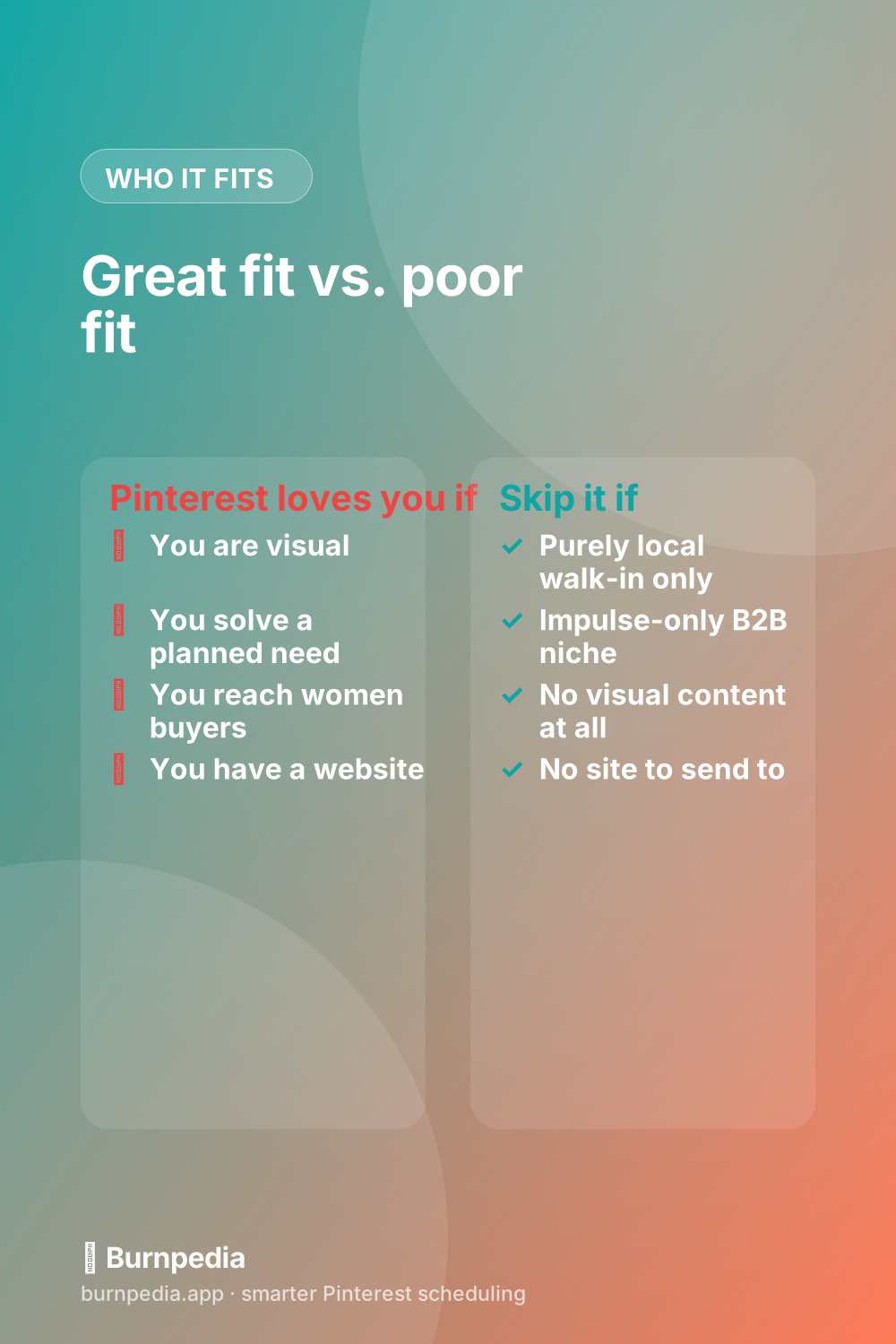
Pinterest tends to be fantastic for businesses that are visual, solve a planned or aspirational need, and have somewhere to send people. Think bloggers and content creators, e-commerce and handmade shops, food and recipe sites, home and interior brands, weddings and events, fashion and beauty, digital products and courses, coaches and service providers with a clear visual angle. If your customer might realistically search Pinterest for something you offer — a recipe, an outfit, a room makeover, a planner, a wedding idea — you are in the sweet spot. I break down the fundamentals for exactly these businesses in Pinterest marketing for small business.
There is also a demographic reality worth naming plainly: Pinterest skews toward planners and toward women, and it has enormous purchasing intent — people are often there specifically to decide what to buy or do next. If that is your customer, Pinterest puts you in front of them at the exact moment they are open to being influenced, which is a rare and valuable thing.
Who should probably skip it
Now the honest other side. Pinterest is a poor fit for some businesses, and you should know if you are one before investing. If you are a purely local, walk-in-only operation with no online offering and no website to send people to, the traffic Pinterest generates may not translate into anything useful. If you are in a dry, non-visual, impulse-only niche with no planning behavior around it, you will struggle to make content that fits the platform. And if you have absolutely no visual content and no way to create any, Pinterest — a visual platform — is going to be an uphill battle.
That said, even some businesses that look like a poor fit have a real angle if they get creative — a local service business, for instance, can absolutely work on Pinterest with the right approach, which is why I wrote a dedicated guide on it: Pinterest for local businesses. The point is not to rule yourself out too fast, but to be honest about whether people actually plan or search for what you do.

How Pinterest compares to other channels
It helps to weigh Pinterest against the alternatives, because "worth it" is always relative to what else you could do with the same hours. Compared to fast-moving social platforms like Instagram or TikTok, Pinterest is slower to reward you but far more durable — a post there dies in a day or two, while a pin can send traffic for years. Compared to paid ads, organic Pinterest is cheaper and the reach is owned rather than rented, but it demands patience and consistency instead of a credit card. And compared to blogging and Google SEO, Pinterest is often faster to show early results and pairs beautifully with a blog, acting as the discovery engine that feeds your site.
That comparison usually clarifies the decision. If you need instant reach and have a budget, ads or a hot social platform may serve a short-term goal better. But if you are building something durable — a blog, a shop, a content library you want to keep paying you — Pinterest is one of the highest-leverage long-term channels available, precisely because the work compounds and the traffic sticks around. For most small businesses and creators the smartest answer is not either-or but a stack: let Pinterest be your patient, compounding discovery layer while faster channels handle the immediate stuff. Judged as a long-term traffic investment rather than an overnight one, Pinterest earns its place for the businesses it fits — and that reframing, from "quick win" to "compounding asset," is usually what turns the worth-it question into a confident yes.
What Pinterest actually costs
Here is the part people underestimate. Organic Pinterest is not free — it costs time and patience, which for a business owner are the scarcest resources of all. You need to create visual pins consistently, target real keywords, and show up steadily for months before the compounding kicks in. Pinterest is famously a slow burn; I laid out the honest month-by-month arc in how long Pinterest takes to work, and the headline is that you should plan for a three-to-six-month runway before you judge results. If you cannot commit to that consistency, the ROI math falls apart no matter how good the fit.
The flip side of that cost is what makes it worth it: unlike ads, the traffic is durable. A pin you make today can keep sending visitors for years, so the effort compounds instead of evaporating the moment you stop paying. That is a fundamentally different deal than paid channels, and it is why patient businesses love Pinterest. If you want to weigh the fast-but-rented reach of ads against the slow-but-owned reach of organic, Pinterest ads vs. organic walks through the trade-off.
A simple way to decide
Run your business through five quick questions. Can you show what you offer visually? Do people plan or search for it rather than only buying on impulse? Is your audience the kind of person who uses Pinterest? Do you have a website, shop, or landing page to send them to? And can you realistically commit to publishing consistently for three to six months? If you answered yes to most of those, Pinterest is very likely worth it, and the smart move is to start now. If you answered no to several, your energy is probably better spent on a channel that fits you better — and that is a perfectly good answer too.
So, is Pinterest worth it for your business? The honest answer is: it depends, and now you have the framework to answer it for yourself instead of taking a guru guarantee at face value. For visual businesses that solve a planned need and can commit to the runway, Pinterest is one of the best long-term traffic investments available, precisely because the work compounds and the traffic sticks. For everyone else, it is okay to say no and put your effort where it fits. The businesses that win on Pinterest are the ones that were a good fit and knew it — and then showed up consistently long enough to collect the payoff. — Sadie
Written by Sadie Brooks
Hey — I’m Sadie. I grew up in a small town outside Columbus, Ohio, moved to Austin for a job I quit within a year, and somewhere in between I started a scrappy little food blog to keep myself sane.
These days I help creators, bloggers, and small U.S. business owners grow on Pinterest without turning it into a second full-time job. I write the Burnpedia blog because I genuinely love this stuff, and because I wish someone had explained it to me in plain English years ago. Pour a coffee, pull up a chair.
Try Burnpedia freeWant Pinterest to run itself?
Every tip on this blog gets easier when your Pins publish on schedule. Burnpedia batches, times, and posts them for you — start free, no credit card.
Try Burnpedia free