How Long Does Pinterest Take to Work? A Realistic Timeline
The single biggest reason people fail at Pinterest is quitting too early. Here is a realistic timeline of what actually happens month by month, so you know whether to keep going or change course.


I am going to save you from the single most expensive mistake on Pinterest, and it is not a design choice or a keyword or a posting time. It is quitting too early. More people fail at Pinterest for this one reason than every other reason combined — they treat it like Instagram or TikTok, expect something to happen in the first couple of weeks, see silence, and walk away convinced it does not work for them. And here is the tragic part: an enormous number of them quit in the exact window right before their account was about to turn the corner. So let me give you an honest, realistic timeline, so you know what normal looks like and can hold on long enough to win.
The mental model that fixes everything is this: Pinterest is a search engine and a library, not a social feed. On Instagram, a post lives for 48 hours and dies. On Pinterest, a pin you publish today can still be sending you traffic two years from now. That is an amazing deal, but it comes with a catch — it pays you back on a delay. You are planting seeds, and seeds do not sprout the afternoon you plant them.
Month 1: crickets (and that is completely normal)
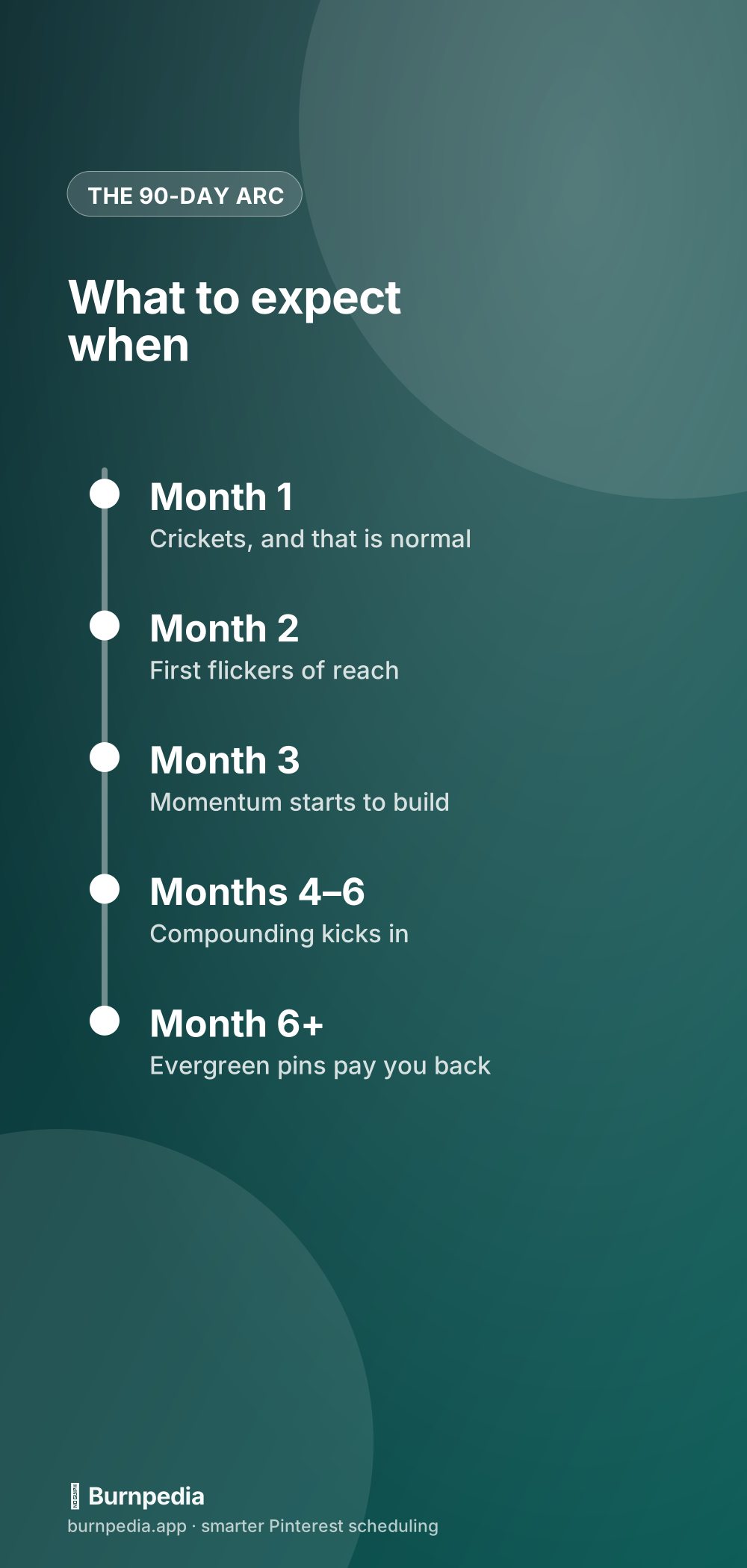
Your first month will feel like performing to an empty theater, and I need you to expect that so it does not break your spirit. A brand-new account has no track record, so Pinterest shows your pins cautiously to a tiny audience while it figures out what you are about and whether people respond. You might see a handful of impressions and almost no clicks. This is not failure — it is the platform doing its due diligence. The correct move in month one is to ignore your stats almost entirely and focus purely on establishing your foundation: a clear niche, keyworded boards, and a steady flow of fresh pins. I laid the whole opening playbook out in the new account strategy.

Month 2: the first flickers
Somewhere in month two, if you have kept publishing, you will start to see flickers. A pin gets a few saves. Impressions tick up from single digits to hundreds. Maybe a pin sends you your first real clicks. It is still small — do not expect fireworks — but the line stops being flat, and that change in direction is the most important signal there is. It means Pinterest is starting to trust you and test your pins with slightly bigger audiences. Your job in month two is exactly the same as month one: keep feeding it fresh pins and resist the urge to overhaul everything because it is not exploding yet.
Month 3: momentum builds
Month three is usually where it starts to feel real. The pins you published back in month one have had time to marinate, get distributed, and prove themselves, and a few of them begin to gain traction. This is the compounding starting to switch on: your library is bigger, your best pins are surfacing, and new pins get distributed a little faster because you have a track record now. This is also the first month your metrics are worth studying seriously, because you finally have enough data to see which topics and designs your audience actually responds to.
What to do while you wait
The hardest part of the timeline is the early stretch when nothing is visibly happening, so let me give you productive things to do with that impatience instead of letting it curdle into doubt. The quiet months are not dead time — they are when you build the library and the skills that make the later payoff possible. Use them well and month six arrives faster and bigger; waste them refreshing your stats and it arrives slower and smaller, if at all.
Concretely: keep shipping fresh pins on a steady cadence, because those exact pins are what will compound later. Use the slow weeks to get genuinely good at writing searchable titles and designing pins people click, since a small skill improvement now multiplies across every future pin. Build out your boards and your keyword list so you always know what to pin next. And deliberately ignore your day-to-day numbers — check them once a month at most in the early going, because staring at a flat line daily is how good creators talk themselves into quitting. Treat the first ninety days like laying track: unglamorous, invisible from the platform, and completely necessary for the train that runs on it later. The people who use the waiting period to build instead of despair are the ones standing there when the compounding finally switches on.
Months 4 to 6: compounding kicks in
This is the stretch that separates the people who win from the people who quit, because by now the quitters are long gone and you are still here — and the math starts working in your favor. Every fresh pin adds to a growing library of evergreen content that keeps circulating. Your winners from earlier months are now steady traffic engines. Pinterest trusts your account, so new pins get a fairer shot faster. Growth in this window often stops being linear and starts curving upward, which is the whole reason Pinterest is worth the slow start. The compounding you were promised is finally visible.
To be clear, none of this is guaranteed on a fixed date. Some niches warm up faster, some slower; a great strategy compresses the timeline and a sloppy one stretches it. But the shape is remarkably consistent across accounts: quiet start, flickers, momentum, then compounding. If you are staring at a flat month three and panicking, the fuller diagnostic in why your Pinterest is not growing will help you tell the difference between “too early” and “something is actually off.”
Why consistency is the whole game
Here is the uncomfortable truth about that timeline: it only works if you keep publishing the entire time. The compounding in months four through six is built entirely out of the pins you shipped in months one through three, when it felt pointless. Stop pinning in month two because “nothing is happening,” and there is nothing to compound in month five. The people who break through are simply the ones who kept feeding the machine through the boring early stretch. That is why I am borderline obsessive about scheduling pins the smart way — because the whole strategy lives or dies on whether you can stay consistent through the quiet part, and willpower alone will not carry you there.
So set your expectations correctly before you begin, and you will beat the vast majority of people who ever try Pinterest — not because you are more talented, but because you understood the timeline and they did not. Give it a real ninety-day runway before you judge it, and ideally six months before you decide whether to double down. Plant consistently through the quiet weeks, trust that the seeds are in the ground even when nothing has sprouted, and let the compounding do what it always eventually does. Pinterest works. It just works on its own schedule, and the reward goes to the people patient enough to wait for it. — Sadie
Written by Sadie Brooks
Hey — I’m Sadie. I grew up in a small town outside Columbus, Ohio, moved to Austin for a job I quit within a year, and somewhere in between I started a scrappy little food blog to keep myself sane.
These days I help creators, bloggers, and small U.S. business owners grow on Pinterest without turning it into a second full-time job. I write the Burnpedia blog because I genuinely love this stuff, and because I wish someone had explained it to me in plain English years ago. Pour a coffee, pull up a chair.
Try Burnpedia freeWant Pinterest to run itself?
Every tip on this blog gets easier when your Pins publish on schedule. Burnpedia batches, times, and posts them for you — start free, no credit card.
Try Burnpedia free