What Happened to Idea Pins? Pinterest’s Format Shuffle, Explained
If you are confused about idea pins, story pins, and what Pinterest even calls things now, you are not alone. Here is the plain-English history of the format shuffle and what to actually do about it.


If you have spent any time on Pinterest in the last few years, you have probably had this exact experience: you learn what an “idea pin” is, you get comfortable with it, and then Pinterest quietly renames it, reworks it, or folds it into something else, and you are left wondering whether the thing you learned still exists. You are not imagining it and you are not behind — Pinterest genuinely has shuffled its native format repeatedly, changing names and rules along the way. Let me give you the clear, plain-English version of what actually happened, so you can stop chasing the branding and start making good decisions.
Here is the reassuring part before we dive into the history: the underlying strategic choice has never really changed, even as the labels did. There has always been a native, engaging, in-app format that gets reach but struggles with links, and there has always been the standard pin that reliably sends traffic. I compared those two head to head in idea pins vs. standard pins, and that core trade-off survives every rename. Learn the trade-off and the naming churn stops mattering.
The short history of the format
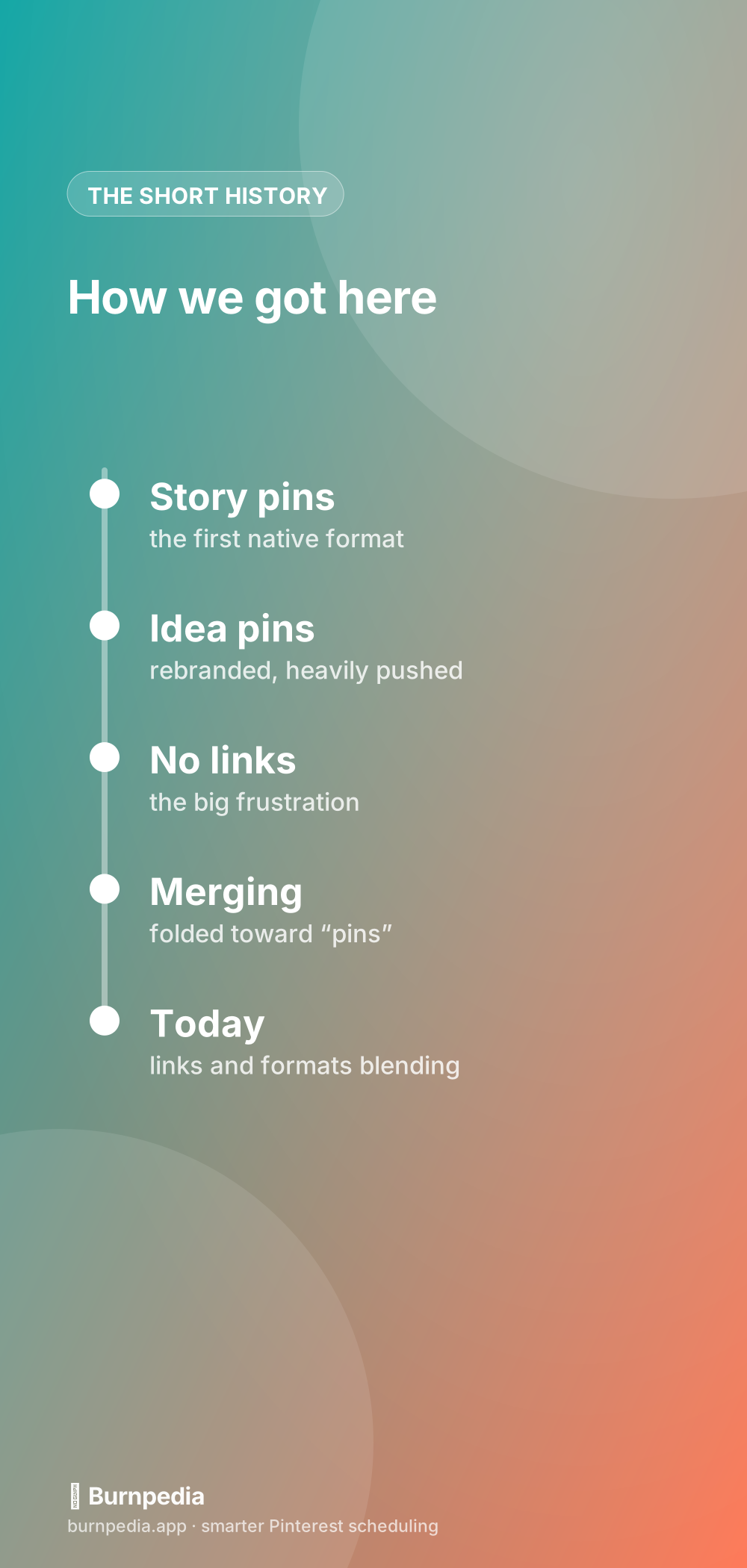
Let me trace the arc quickly. Pinterest first introduced a native, multi-page, full-screen format under the name “story pins” — its answer to the stories and short-video wave sweeping every platform. Then it rebranded that format to “idea pins” and pushed them hard, giving them prominent placement and encouraging creators to make them with promises of extra reach. For a stretch, idea pins were the thing every guru told you to prioritize, and a lot of people reorganized their entire strategy around them.
The friction was always the same, and it was a big one: for most of their life, these native pins could not carry a clean, clickable link to your website. You could get lots of views and saves, but turning that attention into actual traffic was difficult or impossible. For creators whose whole goal was sending people to a blog or shop, that was a dealbreaker, and a lot of frustration built up around pouring effort into a format that looked great but did not drive clicks.
Why Pinterest kept changing it
So why the constant reshuffling? Two forces, mostly. First, Pinterest was chasing the same short-form, full-screen engagement that was winning attention everywhere else, and it kept iterating to find a version that worked for its search-driven audience. Second, it was trying to balance two things that pull in opposite directions: keeping people inside the app (which favors linkless, engaging native content) and keeping creators and businesses happy (who need links and traffic to justify the effort). Reconciling those is genuinely hard, and the repeated renames and reworks were Pinterest feeling its way toward a compromise.
Over time, the trend has been toward merging and simplifying — folding the various formats back toward a more unified idea of a “pin,” and gradually improving links and blending capabilities so the hard wall between “reach format” and “traffic format” softens. The direction of travel is encouraging: fewer confusing labels, more overlap between engaging content and linkable content. But it is still evolving, which is exactly why any post that names specific current features risks being stale next quarter. That is also why I lean on principles over the feature-of-the-month, the same way I do with fresh pins.

The lesson hiding underneath the churn
Step back from the specific renames and there is a genuinely useful lesson in this whole saga, one that applies far beyond idea pins. Platforms constantly chase whatever engagement trend is winning elsewhere, and they will happily push creators toward new formats with promises of extra reach — then quietly change the rules, the name, or the whole feature when it does not pan out the way they hoped. The creators who got burned were the ones who bet their entire strategy on the hyped format of the moment. The creators who stayed steady were the ones who treated new formats as experiments to layer on top of a durable foundation, not replacements for it.
So the practical takeaway is to build your Pinterest presence on the things that do not change, and treat everything trendy as optional seasoning. What does not change: people search Pinterest for ideas, keywords help them find you, good design earns the click, links drive the traffic that pays you, and consistency compounds. Those fundamentals have survived every rebrand and will survive the next one. When Pinterest rolls out its next shiny format, by all means test it — early adopters sometimes do catch a reach wave — but do it with a small slice of your time while your dependable standard-pin engine keeps running underneath. That way, whether the new format becomes permanent, gets renamed twice, or vanishes entirely, your traffic never depended on it. The gurus who told everyone to go all-in on idea pins were not malicious, they were just confusing "what Pinterest is promoting right now" with "what will reliably drive results," and those are rarely the same thing. Own the fundamentals, rent the trends, and you will never get whiplash from a Pinterest announcement again.
What this means for you today
Cut through all of it and here is the practical guidance, which is durable regardless of what Pinterest calls things next month. Do not build your entire strategy around whatever native format Pinterest is currently promoting, because it will change. Keep the standard pin as your reliable traffic workhorse — it has quietly outlasted every trend and still does its job. Use the engaging native format as an awareness and audience play when you have the time, understanding that its strength is reach and saves, not clicks. And judge every format by the job it does for you, not by how heavily Pinterest is pushing it.
- Standard pins remain your dependable traffic driver — keep them central
- Use the native story format for reach and personality, not primarily for clicks
- Do not overhaul your strategy every time Pinterest renames something
- Watch your own analytics to see which formats actually perform for you
- Favor durable principles over the feature Pinterest is hyping this quarter
If you want the full menu of what exists right now and when to reach for each, every pin format explained lays them all out. And for the specific case of motion — which has stayed valuable through every rename — the video pins guide covers the format that has arguably aged the best of all.
So the next time Pinterest renames, reworks, or retires a format and your feeds fill up with panic, you can relax. You understand the deeper structure now: there is a reach format and a traffic format, the labels rotate but the trade-off does not, and the standard pin keeps quietly doing its job through all of it. Pay attention to what each format actually does for your goals, ignore the branding churn, and keep publishing consistently. The creators who stay calm through the shuffles — and keep shipping — are the ones who win regardless of what any of it is called this year. — Sadie
Written by Sadie Brooks
Hey — I’m Sadie. I grew up in a small town outside Columbus, Ohio, moved to Austin for a job I quit within a year, and somewhere in between I started a scrappy little food blog to keep myself sane.
These days I help creators, bloggers, and small U.S. business owners grow on Pinterest without turning it into a second full-time job. I write the Burnpedia blog because I genuinely love this stuff, and because I wish someone had explained it to me in plain English years ago. Pour a coffee, pull up a chair.
Try Burnpedia freeWant Pinterest to run itself?
Every tip on this blog gets easier when your Pins publish on schedule. Burnpedia batches, times, and posts them for you — start free, no credit card.
Try Burnpedia free